
A very short khutbah on the Hajj
By Arshad Gamiet
Hajj: The Journey Back to Allah
By Arshad Gamiet
“A-úthu billáhi minash shaytánir rajeem. Bismilláhir rahmánir raheem. Al hamdu lillahi nahmaduhu wanasta’eenahu, wanastagh-firuhu, wanatoobu ilayhi, wana’oothu Billaahi min shuroori an-fusinaa, wamin sayyi aati a’maalinaa. May-Yahdillahu fa huwal muhtad, wa may-yudlill falan tajidaa lahu waliyan murshida. Wa ash-hadu an Laa ilaaha ill-Alláh, wahdahoo laa shareeka lah, wa ash-hadu anna Muhammadan ‘abduhoo warasooluh.”
All Praise is due to Alláh. We praise Him and we seek help from Him. We ask forgiveness from Him. We repent to Him; and we seek refuge in Him from our own evils and our own bad deeds. Anyone who is guided by Alláh is indeed guided; and anyone who has been left astray will find no one to guide him. I bear witness that there is no god but Alláh, the Only One without any partner; and I bear witness that Muhammad, peace and blessings on him, is His servant and His messenger.
“Ya Ay-yuhal-latheena ‘aamanut taqul-laaha, haqqa tuqaatihee wala tamutun-na il-la wa antum Muslimoon.”
O you who believe — be aware of Allah, with correct awareness, an awe-inspired awareness, and die not except as Muslims.
“Ya Ay-yuhal-latheena ‘aamanut taqul-laaha, wa qooloo qawlan sadeedaa. Yuslih-lakum a’maalakum wa yaghfir lakum thunoobakum, wamay yu-til-laaha warasoolah, faqad faaza fawzan atheemaa.”
O you who believe — be aware of Allah, and speak a straightforward word. He will forgive your sins and repair your deeds. And whoever takes Allah and His Prophet as a guide has already achieved a mighty victory.
My Dear Sisters and Brothers,
At this very moment, millions of pilgrims are preparing for the Hajj — the most important journey in a Muslim’s life. Hajj is the 5th and final pillar of Islam. But it is far more than a ritual. It is the dramatic story of our entire Deen, told in movement, in landscape, and in remembrance.
Hajj begins with our Fitra — our primordial human nature, the way Allah made us. We were born innocent and pure, without sin. But Allah also made us forgetful. We are easily distracted. It is this tendency — to lose focus, to drift — that leads us to slide into sinful and shameful behaviour.
But here is the great gift: Hajj also offers redemption. Divine Mercy. Forgiveness. Allah reminds us never to despair of His Mercy. If we sincerely stop our bad behaviour and return to His obedience, His forgiveness is complete.
When we arrive at the Kaaba, we find ourselves at the Baytul-Laah — the House of Allah. The first place of worship ever built on this earth. Before the first church, before the first temple or synagogue. This is the geographical centre of Islam, the cradle of Tawheed, of Divine Unity.
Our tawaaf around the Kaaba symbolises effort and action — constant, circular motion — centred around a fixed and immovable truth: the Oneness of Allah. Just like the Kaaba itself stands firm while the world swirls around it, Tawheed stands firm amidst all our individual differences and changing circumstances.
Then we come to the great plain of Arafat, and here time itself seems to collapse. Long before the Big Bang, 14 billion years ago, long before time and space existed, Allah gathered every soul that ever was and ever will be. He addressed that immense assembly and asked:
“Alastu bi Rabbikum?” — “Am I not your Lord?”
And every soul replied, in one thunderous voice: “Balaa shahidna” — “Yes, indeed! We testify!”
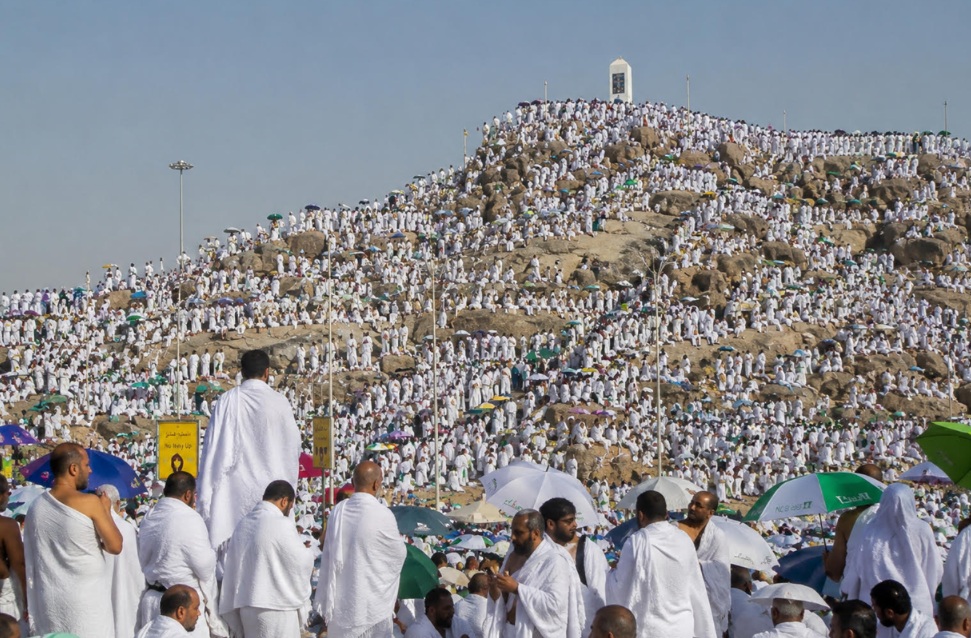
That was the very beginning. And the gathering on Arafat is also a glimpse of the very end. It is a dress rehearsal for Yawmul Qiyaamah — the Day of Judgement. Look around you on that plain. Millions upon millions of people, all in simple white ihram. You cannot tell who is rich and who is poor. The president, the billionaire, the taxi driver, the school teacher and the farmer — they all look exactly the same.
This is exactly how Allah sees us. He is not looking at our designer clothes or our social status. He is only looking at what is inside. What is inside our hearts? Is it full of anger, jealousy, hatred and vanity? Or is it full of love, mercy and generosity? Have we purified our spiritual hearts? Do we have a Qalb saleem — a sound, pure heart? Allah warns us that no one shall enter the Garden except those who come with a sound heart. [Quran 26:87–89]
We then climb Jabal Rahma — the Mount of Mercy — rising above the plain of Arafat. Here we stand not only as Muslims, but as Bani Adam — the children of Adam and Eve. Here is where our first parents stood, where they recognised their mistake, felt the weight of their disobedience, and pleaded with their Lord:
“Rabbana zhalamna an fusina wa il-lam tagh-fir lana wa tar hamna lana koonanna minal khaasireen!”
“Our Lord! We have truly wronged our own souls, and if You do not forgive us, we will truly be among the losers!” [7:23]
Nabi Adam’s journey began in primordial innocence. Then came forgetfulness, distraction, disobedience — the first sin. But Allah gave Adam the ability to recognise his mistake, to feel remorse, to plead for forgiveness, and finally to earn redemption. Brothers and sisters, this is the same journey that you and I must take. We were all innocent once. We got distracted. We forgot and we sinned. Now it is time to follow Nabi Adam’s example.
If you have not yet undertaken this blessed journey, make your niyyat — your intention — to perform your Hajj as soon as possible, insha’Allah.
When you put on your ihram, you repeat those evocative words:
“Labbaik, Allahumma labbaik!” — “Here I am, O Allah! Here I am!”
Allah has honoured you with His invitation. You are Allah’s guest. And as His honoured guest, you must observe the finest manners at all times.
My dear respected sisters and brothers,
Hajj is an outward journey tracing the spiritual history of Islam. But it is also an inward journey — one that you and I must undertake every day, to find our own centre, in the Kaaba of our heart.
What desires, what emotions and passions are still circling, still making tawaaf around our spiritual heart? The qalb — the spiritual heart — is the true seat of our personality. It is our real driving force. Let us make sure it is always filled with loving thoughts of Allah, and with gratitude for His countless blessings.
Dhikr is not just words of praise. It is not just a warm feeling. It is words and actions. It is making our love for Allah visible — through big and small acts of kindness towards others.
“Al-latheena ‘aamanu, watat-ma-innul quloobuhum, bi dhikril-Laah. Alaa bi dhikril-Laahi tat-ma-innul quloob.” [Sura al-Ra’d, 28]
“Those who believe, and whose hearts find contentment in the Remembrance of Allah — for truly, in the Remembrance of Allah do hearts find contentment.”
We often say we love Allah more than anything or anyone else. But do we really mean it? Talk is cheap. Where is the evidence? If we truly love someone, there is evidence — there are phone calls, messages, gestures of devotion. Where is the evidence of our love for Allah?
Nabi Ibrahim, alayhis salaam, was willing to sacrifice his own beloved son for Allah’s sake. Both father and son passed the most demanding test of sincerity — ikhlaas. And Allah spared Ismail. Their love was proven in action.
How much are you and I willing to sacrifice for Allah? Let us prove our love — not in words, but in deeds. Let us serve His creation. Let us be agents of His mercy in our families, our neighbourhoods, our communities. Our beloved Prophet, peace and blessings upon him, was “Rahmatul lil aalameen” — a mercy to all the worlds. He advised us:
“Spread peace, feed the poor, pray a part of the night, and you will enter Paradise.” [Hadith]
Let us pray for all the hujjaj that Allah accepts their Hajj. And let us pray for those who have not yet gone, that Allah makes it easy for them, very soon, insha’Allah.
O Allah, forgive us all. Have mercy on us. Remove the pain and suffering of our brothers and sisters across the world. Say: Ameen!
“Surely Allah commands justice, good deeds, and generosity to others and to relatives; and He forbids all shameful deeds, injustice and rebellion. He instructs you, so that you may be reminded.” [16:90]
“Remember Me — I will remember you. Be grateful to Me, and do not reject faith.” [2:152]
“And without doubt, Remembrance of Allah is the greatest thing in life.” [29:45]
Ameen. Aqeemus salaah!